|
| |
|
Synthetic Diamonds: What You Must Know NOW to Avoid the Traps - June
1999
The Diamond Registry Bulletin has been reporting on the synthetics
issue for 29 years, but now it has become more than just a theoretical problem. The advent
of the availability of gem-quality synthetic diamonds opens two traps for jewelers: the
unscrupulous scam artist and, sadly, the investigative reporter who creates a sensation
along with his story by embarrassing uninformed jewelers.
Long-time readers with good memories may recall the August 1970 issue
in which the DRB stated: "We believe GE will try, and eventually succeed
in, manufacturing large diamonds at low prices [Should this] cause worry to diamond
merchants and the public investing in diamonds? The answer is a definite no." As
usual, experience is the best teacher here: fancy-colored diamonds can be worth hundreds
of thousands of dollars, but cyclotron-bombarded fancy colors, while beautiful and even
permanent, simply cannot command prices close to the natural fancy colors. The same wide
gap in price is evident between synthetic and natural emeralds, rubies and sapphires.
Those that are man-made can be bought on the street for a few dollars. Yes, there is a
market for both natural and synthetic diamonds, but they rarely compete.
Again, in June 1992, the DRB clarified the situation in
the midst of industry nervousness, "[the Swarovski family firm] decided not to
sell lab-made diamonds after a Boston Consulting Group (BCG) study found consumers were
unwilling to pay high prices for synthetics." The DRB had also spoken with
General Electric "whistleblower" Edward J. Russell. Russell
confirmed BCGs findings saying "a natural diamond meant love to consumers
and a synthetic wasnt the same."
Where gem-quality synthetics were once only talked about within the
industry as a "what if," and rarely discussed in the media, the synthetic
diamond is now being produced without the extremely high pressures and temperatures
requiring the large and expensive equipment of the past and being produced at lower than
natural diamond costs. It may only be a question of time before the media begins to test
jewelers on their diamond knowledge as it already has done with synthetic moissanite, a
diamond simulant.
The Moissanite Trap: Even Her Jeweler Doesnt Know!
On Wednesday, May 19th, the Fox Networks Ten Oclock News
ran a story on moissanite and how easy it is to fool the industry. A piece of jewelry
set with moissanite was taken to several jewelers and to the laboratory of the International
Gemological Institute (IGI). Of the jewelers, only those with the special C3
moissanite tester or one of the less expensive generic testers, could tell the
difference. The DRB interviewed Mark Reyes, Laboratory Director at IGI, and
got some pointers on detecting synthetic moissanite. "Once you have the training,
detection becomes very easy," said Reyes. And, that does seem to be the case: IGI
passed the test with flying colors. Reyes said that, for set stones, the best test is one
of refraction. Moissanite is doubly refractive with a birefringence of 0.043 (diamonds
have none). That means that moissanite will show doubling of the rear facets when viewed
at an angle. Reyes said, "You can use a microscope, but a trained gemologist or even
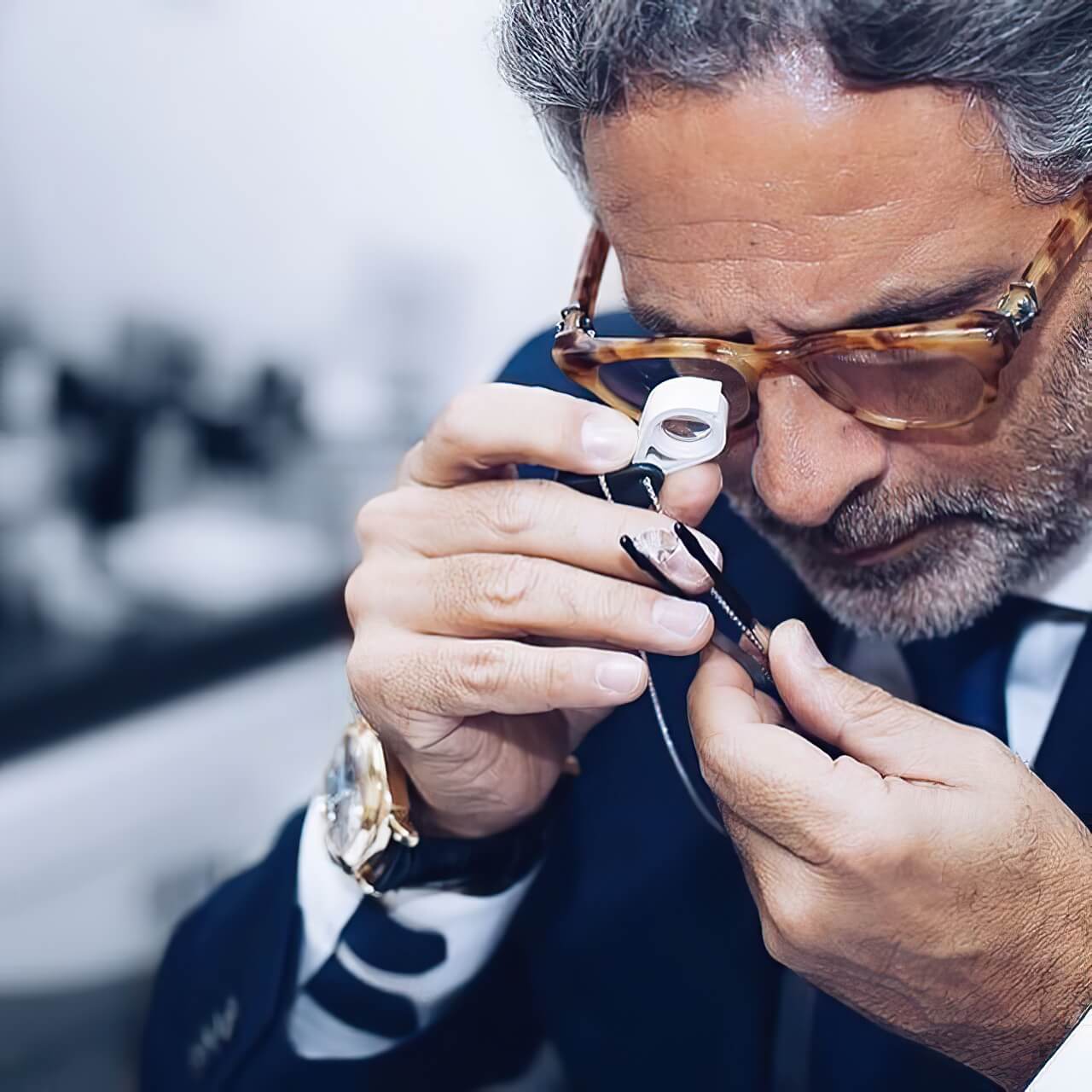
somebody with good experience with gems should be able to tell using a loupe." To
test: turn the stone so that you can see a reflection of the Culet through a bezel facet. If
you see double, its no diamond!
In loose stones, of course, it is much easier to tell the difference,
its when the stone is mounted that things become more complicated and the standard
diamond tester, made to discern CZ, wont help with moissanite. Jewelers can purchase
moissanite testers from the Gemological Institute of America (GIA) by calling the
gem instruments office 1-760-603-4500. However, there are ways to discern moissanite from
diamonds without one of these testers:
Synthetic moissanite has a higher refractive index, similar to peridot
1.648-1.691 compared to a diamonds 2.417.
A diamonds dispersion 0.044 is much lower than is
moissanites at 0.104.
And the sure-fire tip-off for loose stones? Moissanites specific
gravity is 3.22 which means that it floats in 3.32 liquid (pure methylene iodide),
where a diamond at 3.52 specific gravity will always sink.
What with the growing sales of synthetics - and moissanite-related
scams on the rise - some clarification should be made as to the difference between
synthetic diamonds and moissanite. Synthetic diamonds are actually laboratory-produced
diamonds whereas moissanite is a diamond simulant like CZ, a synthetic silicon carbide
manufactured by the Morrisville, North Carolina-based company, C3. Moissanite is not
a synthetic diamond.
The Synthetics Manufacturers
While the biggies GE, Sumitomo and De Beers itself have
not marketed gem-quality synthetics as of yet, the smaller producers, using what seem to
be inexpensive methods to produce their goods, are coming to the fore.
Long expected to be the first producer of gem-quality synthetic
diamonds, was Chatham Created Gems, Inc., with Thomas Chatham at the helm.
Chatham tried to produce synthetic diamonds in Russia but was unable to turn the quantity
necessary. The Company is now trying to bring the Russians here and is currently at work
on its own scientific model. The Company does produce one of the most popular synthetic
emeralds, as well as other colored stones, but Chatham does not yet manufacture synthetic
diamonds. The Company does have the scientific model for production but, "For De
Beers its cheaper to dig out the diamonds, for me its cheaper to make
them," Chatham said.
One enterprise already turning out high-quality synthetic diamonds is
the Morion Company, based in Brighton, Massachusetts and, again, scientifically led
by Russians. The DRB talked to Leonid Pride, one of the founders of Morion
who now works as a consultant with the Company. When discussing synthetic diamonds
its important to remember that they are diamonds, just not naturally
occurring stones. The only difference being that the crystal has been grown in the
laboratory rather than dug out of the earth. Morion supplies rough synthetics to a number
of famous US gem cutters and hopes eventually to move into the polishing end of the
business.
At the moment, Morion has quantities of near colorless stones of up to
1.25 carats, rough. This means, of course, that the largest cuttable from these rough are
.60-.70. So far Morion has not moved into producing larger stones but Pride said the
Company hopes to have larger stones available in the near future. Morion has also managed
to produce synthetic GIA type IB fancy-yellow diamonds and, while only a few blue diamonds
have been produced to date, Morion is working to widen the range of color available.
Prices for the synthetic diamonds are slightly high $550 for 1 carat colorless to
near-colorless Synthetic diamonds, in case youre wondering, are easy for a
laboratory to discern from natural diamonds by their metallic-flux inclusions and their
non-octahedral faces. Synthetic diamonds can even be certified by the GIA; the certificate
will read, "Diamond: Synthetic."
One hears the industry wondering if the "created diamond"
will become as popular as the "cultured" pearl. But the DRB said it then
and now says it again (June 1992), "...we need not fear that artificial diamonds
will reduce the value of natural stones."
Think about it: twenty-nine years ago, no one could have imagined how
deeply and permanently computers would be part of our lives in just a few short years. We
have so many computer-generated things now: animation, sound, photos. But, even as the
words of George Washington as printed from a word processor will never touch the value of
an actual letter penned by our Founding Father; even as a "perfect" Picasso
mimicking every detail will never have the worth of a work painted by the master, each
natural diamond is a unique and ancient masterpiece of Nature herself.
Remember: If we do our jobs well, no customer will ever even consider an artificial
diamond. Have confidence in your product it is an extraordinary one. Protect your
reputation your customer should know that you, like Tiffany, would never sell
a synthetic diamond or even a treated natural diamond in some underhanded manner. Educate
your customers they deserve your attention and care. Now get or even a treated
natural diamond in some underhanded manner. Educate your customers they deserve
your attention and care. Now get out there and sell some real diamonds! v
|
|
|